Dr.
Ron Rusay Office: PS 235, tel. (925) 969-4216; Office Hours: MW 10:00-11:00, TTh 11:00-12:00 (On-line video/phone conferenceing). Must register on-line, which is good for the entire semster, click on the following links to register for either Tuesday or Thursday or both days (must register separately for each day): Tues: 351-595-876, Thurs: 624-973-702 ; other times by
appointment on request; daily e-mail replies usually within 24 hours.
 E-mail:
rrusay@chemconnections.org
or rrusay@dvc.edu
E-mail:
rrusay@chemconnections.org
or rrusay@dvc.edu
| CHEM-108 Introductory Chemistry, Sections 2341 & 2343 |
| This course is an introduction to the experimental science of chemistry. Using mathematical word problems and chemical terms, the student will have an overview of inorganic chemistry. This course is appropriate for those that have no high school chemistry experience. |
| Units: |
4.00 |
| Grade Code: |
Student choice |
| Repeatability: |
0 |
Prerequisites: MATH-090 or MATH-090E or MATH-090SP or one year of high school algebra or equivalent Recommended
Recommended: Eligibility for ENGL 122 or equivalent
PLEASE CONSIDER CAREFULLY: The
teaching style of
these Chem 108 sections are based upon current research. It supports many different individual learning styles that provides a sound basis and opportunities for each of you to develop an interest & foundational literacy (“knowledge, skills, and fluency”) in chemistry and science, while preparing you for success in subsequent follow-on chemistry courses and ultimately in any career path. It incorporates many innovations in guided
teaching methods & practices, instructional technologies, and pedagogical applications, which depart from, but are
built upon traditional textbook-lecture centered undergraduate courses. The organization
and
approach are likely to be quite different from other courses that you are experienced in and
comfortable
with. The material will not be treated linearly as simple page turning in
relation to a required course textbook. You will be challenged to develop
and use vocabulary, access
a variety of information,
to appraise
its value,
and to use
it constructively
in different contexts, to answer guided questions, to solve practical problems, to understand how you learn, and to build knowledge. You
will have various traditional and digital tools & assets available to you that go well beyond
a traditional textbook
and lecture notes. You will need to decide how to use them effectively, and
to develop your own personal learning plan accordingly. Not all
knowledge
will
be
provided
to you to repeat back accurately for a grade as you are accustomed to in
most courses. Your plan will most likely be different than anyone else's. Without
a plan that you can use productively and adjust as the course progresses,
you will likely not meet your personal objectives. This
metacognitive
approach to teaching-learning will translate to any of your other courses
and more importantly
empower you to effectively address any topic in any discipline at anytime
in your careers. Certain student performance
standards are uncompromising and unconditional. You
are expected to attend each class and lab. You are expected to be punctual
and arrive on time for each class and lab. You
are expected to start promptly at the beginning of each
class and lab. You are expected
to be prepared before coming to each class
and lab by being familiar with what is planned for each class and laboratory, and also be practiced in the vocabulary, skills, and concepts of the previous classes and labs. You
are expected to be informed, attentive & polite to each other throughout each
class and lab. If in the event that you are late or cannot attend a class or lab, please advise Dr. R. by e-mail or phone as quickly as possible and arrangements will be made to assist you.
A. Class Meetings: MW 11:10-12:35 PS277
Lab Meetings: Sec. 2341 M 12:45-3:55 PS217; Sec. 2343 W 12:45-3:55 PS217
Attendance is required in both lecture and laboratory. NOTE: College policy calls for dropping students from a course if 2 weeks of
class or lab are missed cumulatively (in total).
Classes begin: 8/26; Holidays: 9/2, 9/27,
11/11, 11/28-11/29
In-class Exam dates: 9/30, 11/4,
12/11
B. References and Equipment:
1: Principal Resources:
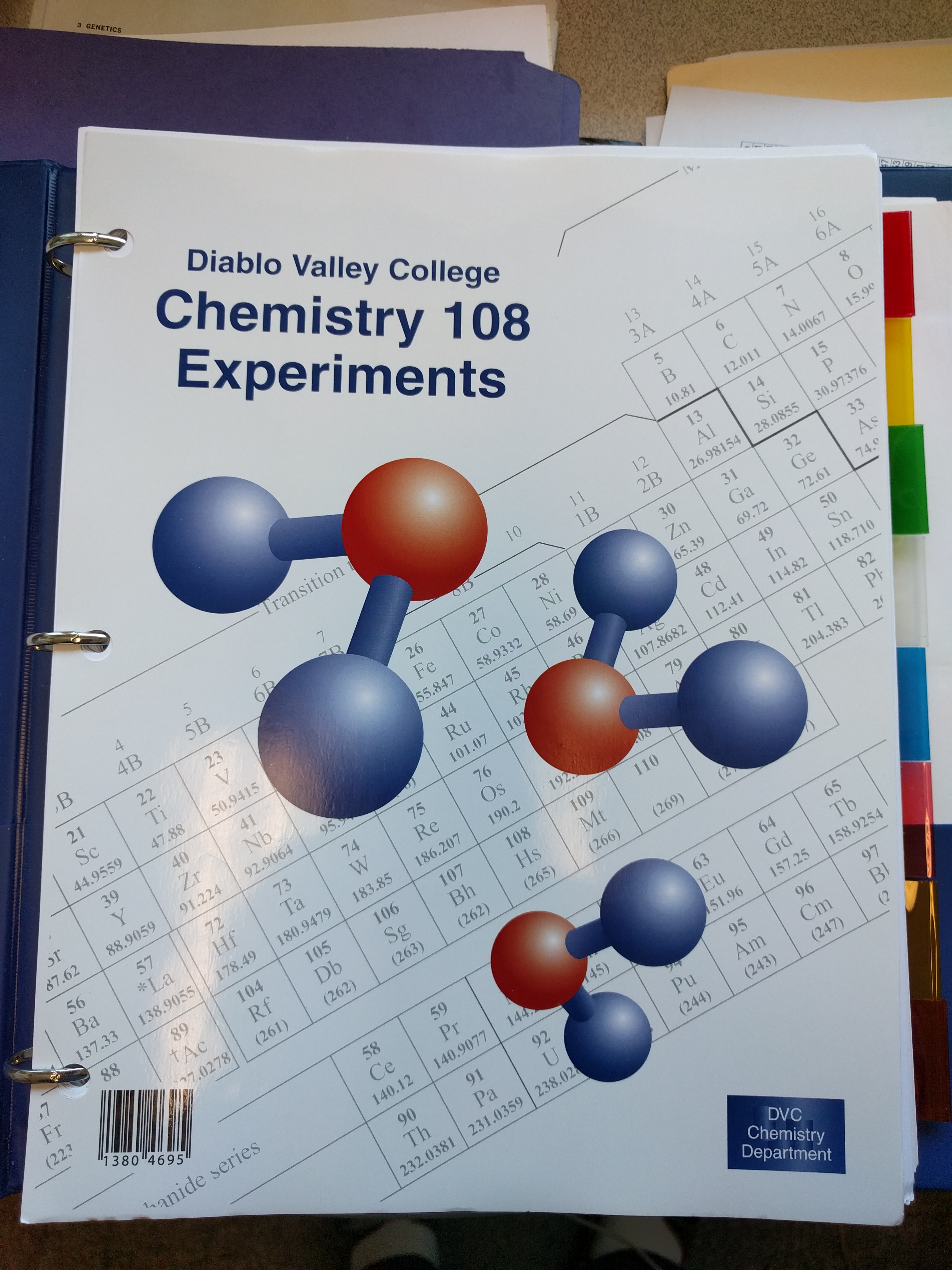
Chem 108 Experiments ($17.95 DVC Bookstore) (REQUIRED/MUST
HAVE)
Webassign (REQUIRED/MUST
HAVE): The following Webassign link and class key must be used to self-enroll on-line in Chem 108 2341-2343 using your name and DVC id number. There is to be a 40 14 day grace period. After that time, a $41.00 payment on-line, which includes access to the Bishop textbook, is required.
https://www.webassign.net/v4cgi/selfenroll/classkey.html
The following Class Key must be used to enroll.
dvc 3947 0654
You can obtain an access code to complete the process by providing an on-line payment of $41.00 at this time, or you can wait until a 14 day grace period ends. If you do not enroll on or before the end of the 40 day grace period, you will loose all credit for 15% of your overall end-of-course maximum possible grade. There will be no exceptions.
NOTE: In purchasing Webassign, be sure to check if the textbooks and instructional materials required in your other DVC courses this semester are published by Cengage, who owns Webassign. If so, it may be more economical to subscribe to Cengage's Unlimited package, which is $119.99 and includes all Cengage resources that would be required in your other courses.
Detailed instructions .pdf
Follow the paragraph after using the Class Key: "
I do not have an access code."
1. Log in to WebAssign. 2. Select purchase access online and click Continue. 3. Select items to purchase, confirm any license agreements, and click Enter payment information. 4. Provide your payment and contact information and click Continue. 5. Review your order and click Complete purchase. 6. Close your receipt and start working in WebAssign."
Please contact me immediately if you are having difficulty with any part of this process.
Webassign enrollment provides access to all of the Webassign resources through your account, which includes An Introduction to Chemistry e-book with associated questions and a broad collection of supporting resources ($41.00): Intro To Chem (With/Webassign) Bishop ISBN 0984337903 Copyright 12 Edition 1Binding Kit/Set/Package
(Hard copies of An Introduction to Chemistry, Atoms First ISBN978-0-9778105 can be purchased @ $74.45.) http://preparatorychemistry.com/Bishop_Payment_text_atoms.htm
One copy is on 3-hour reserve at the DVC Library.
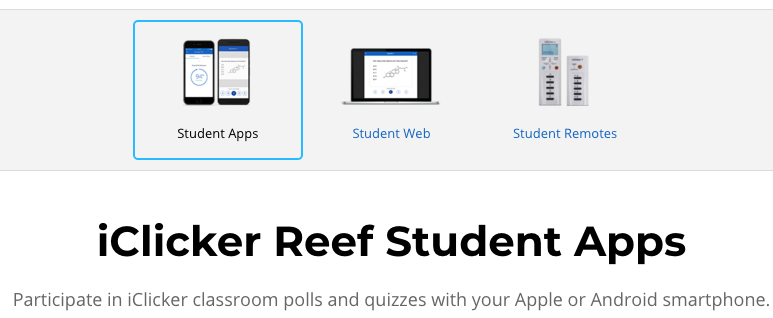
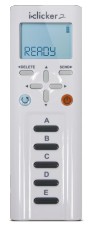
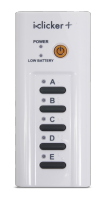
2: i<clicker https://www.iclicker.com/students (REQUIRED/MUST
HAVE) Either an i-clicker app with a Reef account that enables your smart phone, tablet, or wifi connected laptop, or one of the devices shown above (old or new); purchases can be made on-line and possibly through the DVC bookstore. (If you set up a Reef account, you will have a 2 week free-trial period, after that point, you will need to purchase a Reef subscription ($14.99); To enable Reef: set up an account selecting Diablo Valley College Pleasant Hill as your institution, then entering Introductory Chemistry in the search box. Be sure that the confirmation screen shows: Term fall 2019, Start Date July 18, 2019, End Date January 14, 2020, Meeting Times Mon 11:00 AM, Wed 11:00 AM, then click on Add This Course.
3: A personal e-mail account. (REQUIRED/MUST
HAVE)
4: Chem 108 Notebook: (REQUIRED/MUST
HAVE) 3 ring recommended
5: Lab safety glasses with side shields
or goggles. (REQUIRED/MUST
HAVE)
6: Access to the Internet; Can be limited, such as only on the DVC Campus. (REQUIRED/MUST
HAVE)
C. Course Outline/ Objectives / Topics:
Student Learning Objectives (SLOs): The overarching Chem 108 course objective is to provide a learning environment that encourages and enables each student to devleop a personal foundational literacy, “knowledge, skills, and fluency”, within the chemistry domain as outlined in the National Academy of Sciences publication, Science Literacy: Concepts, Contexts, and Consequences (2016). https://doi.org/10.17226/23595
More specifically, students will be able to:
Lecture
- Define introductory chemical terms and give examples of how they are used.
- Apply the chemical knowledge gained by solving mathematical word problems pertaining to a variety of chemical situations.
- Distinguish between various states of matter, elements, ions, and molecules by physical and chemical properties.
- Construct chemical equations, balance them, and calculate product yields utilizing chemical stoichiometry and other knowledge gained in the course.
- Calculate solution concentrations, assess the chemical species present in solutions, and evaluate the physical properties of gases, liquids, solids, and solutions
Laboratory
- Perform a variety of chemical experiments and techniques.
- Record data and observations.
- Apply lecture objectives using data to analyze laboratory results.
Content:
Lecture
- Introduction to experimental science of chemistry
- The Scientific Method
- Metric system, unit conversions, density and temperature
- Significant figures and scientific notation
- The composition of matter
- Physical properties of solids, liquids, and gases
- Atoms, molecules, and ionic compounds
- Chemical formulas and nomenclature
- Atomic theory and the Periodic Table
- Chemical reactions and stoichiometry
- Prediction of products and balancing equations
- Moles, molar mass, percent composition, chemical yields
- Types of chemical reactions
- Chemical equilibrium and Le Chatelier's Principle
- Gas laws
- Solutions
- Solubility rules
- Expressions of concentration i.e. molarity and percent composition
- Acid and base theory
- Strong versus weak acids and bases
- pH scale
- Titrations
- Buffers
- Nuclear chemistry
- Radioactivity and radioisotopes
- Half-lives and radioactive decay pathways
- Uses of radioactivity: medical applications and power generation
Laboratory
- Observe chemical reactions and write balanced equations
- Record data and perform calculations with appropriate significant figures
- Develop laboratory skills such as pipetting, titrations, measuring volume and mass, and qualitative analysis of an unknown
- Draw conclusions by applying lecture topics and vocabulary
D. Class Preparation & Homework: Staying current: developing, practicing, and applying vocabulary, course content & cognitive skills on a daily basis are essential
for
your
success in this course and recommended for all of your courses of study. The amount of preparation,
practice and time required will differ for each of you. In order to score well, the questions to ask yourself while going through
this experience are, "Do I know and understand the meaning of the vocabulary? Do I understand the question? Do I understand the concepts? Can I effectively communicate and explain the question, concepts relating to the question, and an approach to solving the problem to someone else? And,
can I recognize and correctly answer questions that are similar to the ones
contained in
the
Webassign Homework, the i-clicker
response questions,
the
lab worksheets,
the homework problems, the class/lab activities and the Exams' "Practice Questions"?".
Correlating the time related to your answer to these questions will provide
an estimate of what you will likely need to invest. Exams will be designed
to test content & concepts based on these materials. Suggested order of emphasis is: 1) (Refer to the
course calendar
page frequently) Print & read the on-line Class Powerpoint Slides that are linked from
the course calendar & consider possible answers for the i-clicker questions before
coming to each class. The slides are the main resource to guide and focus your attention. Take
in class notes on the printed slides, record i-clicker answers. Review before the next class; one related question will start each following class. 2) Complete and submit all on-line links from the calendar labeled Guided Question. 3) Complete all lab assignments; consulting and collaborating with lab mates is encouraged. 4) Individually complete the Webassign Homework assignments working on them as frequently as posible and submitting the completed assignments before the scheduled due dates; 5) Forming study groups is highly encouraged to test your understanding and to assist you as you deem necessary in developing a level of mastery of the in-class and lab problems and topics. Student tutors are available on a scheduled basis in PS 110. 5) Refering frequently to the calendar and its linked information is an unconditional course requirement. If this is not done prior to bringing any questions forward to Dr. R., those questions will most very likely NOT be addressed nor answered.
E. Grading:
In-class participation / answering i-clicker questions + answering on-line Guiding Questions +
on-line simulations/quizzes are valued at 15% of the TOTAL grade; Webassign homework is valued at 15% of the TOTAL grade; Laboratory activities & related assignments are valued at 25% of the TOTAL grade; 3 "Cumulative" Exams, which include cumulative topics from the beginning of the course, are each valued at 15% of the TOTAL grade.
Exam dates: 9/30, 11/4,
12/11
Final letter grades will be assigned
based on the following normalized final averages: 87-100%
A/A-;
75-86%
B/B-; 60-75% C/C-; 50-59% D; <50% F;
A= Distinguished Performance/ Exceeds Expectations; B= Very Good Performance/ Meets Most Expectations; C= Basic Performance / Satisfactorily Meets Minimal Expectations; D= Poor Performance/ Meets Less than Acceptable Expectations; F= Unacceptable Performance/ Does Not Meet Expectations.
What is normalized grading versus "curving"?
NOTE: The
DVC Code of Conduct will be strictly enforced. Cheating
and plagiarism are unacceptable and will unconditionally result in a failing
grade. [Cell phones will not be allowed in rooms during exams
and quizzes.] SEE:
DVC Academic College Policies
F. Attendance & Absences:
On-time attendance at all scheduled class
and lab meetings and remaining for the entire duration of the session are unconditionally expected.
If you arrive late for class or lab, you may not be allowed into the classroom & will not be given credit for participating in that session. Two late
arrivals will be excused provided that
you advise Dr.
R. immediately after the class or lab as to the circumstances. If you are to leave class or lab early, you are to advise Dr. R. before the beginning of that session to receive participation credit. If you are to miss a class, quiz, exam
or lab due to illness or other legitimate reason, you must advise Dr. R.
prior
to, or on the day that it is scheduled. If you do not do so, there will be
no possibility
of making up any missed work or of being excused from assignments, activities
or the material presented. Notifying Dr. R. can be done by calling: (925) 969-4216 or sending an e-mail to Dr. R. If you
miss a cumulative total of 8 laboratories and/or lectures regardless of the
reasons,
you may be
dropped
from the course. [College
policy provides for a student being dropped from a course if a student
misses a cumulative
total of two weeks of class/lab meetings.]
G. Laboratory:
The laboratory component of the course is skill based and absolutely essential to the
overall course.
A
failing grade in the lab portion will result in a failing grade
for the course. The laboratory curriculum will consist of a set of experiments and activities relating
to the class topics. The lab grade constitutes 25% of the final grade.
_________________________________________________________________________________________________________________
H. Safety:
Laboratory safety is of the utmost importance to your well being
and to your lab mates. Chemical exposure must be minimized through good
lab practices.
All wastes must be properly disposed of, eye protection must be worn at all
times. No one can work in the lab without an instructor being present.
Only scheduled
experiments are allowed. Bare feet, food, drink, eating, and conduct which
places anyone at risk are unacceptable. Violation
of safety standards can result in being dropped from the course.
 CHEMISTRY
108 / Fall 2019: SYLLABUS
CHEMISTRY
108 / Fall 2019: SYLLABUS